
 Local US/Canada
 Toll Free
Key Takeaways
- Canada ranks among the top global hubs for crypto mining, thanks to cheap hydro power and a cold climate.
- Bitcoin miner hardware needs constant power, cooling, and connectivity that most homes can’t provide.
- Provinces like Quebec, Alberta, and New Brunswick each offer distinct advantages for cryptocurrency mining.
- Regulations exist, but no special mining license is required in Canada, just tax compliance.
- Bitcoin Miner Hosting gives miners in Canada turnkey hardware sourcing, hosting, and repair support so they can mine profitably without the guesswork.
Crypto mining Canada has become one of the most talked-about phrases in the digital asset world, and for good reason. As Bitcoin’s global hash rate keeps climbing, Canada has quietly built a reputation as one of the best places on earth to run mining hardware profitably. Between abundant hydroelectric power, a naturally cold climate that cuts cooling costs, and a stable regulatory environment, the country checks nearly every box that a serious miner looks for. Whether you’re an individual with a handful of rigs or a company planning an industrial-scale deployment, understanding why Canada works, and how to do it right can make the difference between a hobby that bleeds money and an operation that actually turns a profit.
Why Canada Is a Magnet for Crypto Mining
Cryptocurrency mining is an energy-hungry business. Every ASIC miner runs around the clock, drawing power to solve the cryptographic puzzles that secure blockchain networks and earn new coins. Since electricity is typically the single largest recurring cost for any operation, location matters enormously.
Canada checks several boxes that make it stand out from other jurisdictions:
- Low-cost hydroelectric power in provinces like Quebec and British Columbia
- Cold ambient temperatures that reduce the need for expensive mechanical cooling
- Political and economic stability, which reduces long-term operational risk
- Reliable, high-speed internet infrastructure required to maintain mining pool connections
- A maturing tech and data center ecosystem that supports large-scale hosting
Canada has grown into one of the largest Bitcoin mining jurisdictions worldwide, with facilities across the country consuming thousands of gigawatt-hours of electricity annually to keep miners running. That scale of energy use is a clear signal of how much confidence the industry has placed in Canadian infrastructure.
The Hardware Behind the Hash Rate
None of this works without the right bitcoin miner hardware. Mining today is almost exclusively done using Application-Specific Integrated Circuits, or ASIC miners, which are purpose-built machines designed to do one job extremely well: solve the proof-of-work puzzles that validate transactions and add new blocks to the chain.
A few realities about modern mining hardware:
- ASIC miners produce significantly more computational output per watt than older CPU or GPU setups, but they also generate substantial heat and noise.
- Hardware efficiency directly affects profitability – older or less efficient machines can become obsolete quickly as network difficulty rises.
- Events like Bitcoin’s periodic halving cut mining rewards in half roughly every four years, which effectively doubles the energy cost of mining each coin and puts even more pressure on miners to run efficient hardware in low-cost power environments.
This is exactly why so many operators are shipping their bitcoin miner hardware to professional facilities instead of trying to run it out of a garage or spare room.
Why Home Mining Rarely Works Out
It’s tempting to think you can just plug in an ASIC miner at home and start earning. In practice, residential setups run into three problems almost immediately:
- Noise: a single ASIC miner sounds like a vacuum cleaner running nonstop, every hour of every day.
- Heat: these machines throw off industrial levels of heat that standard home ventilation simply isn’t built to handle.
- Power limits: most residential electrical panels aren’t designed for the sustained draw of mining hardware, and residential electricity rates can quietly eat away at any rewards earned.
This is the exact gap that professional hosting fills. Instead of wrestling with breaker panels and box fans, miners ship their equipment to a purpose-built data center where power, cooling, connectivity, and security are already handled.
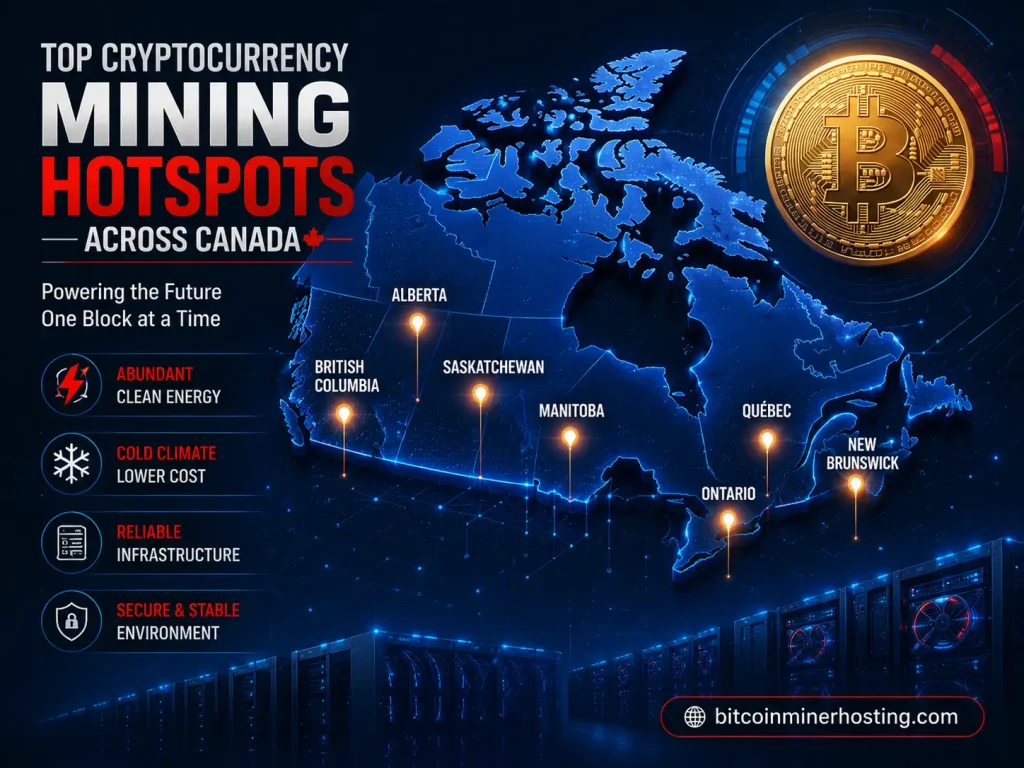
Regional Hotspots for Cryptocurrency Mining in Canada
Crypto mining Canada has become one of the most talked-about phrases in the digital asset world, and for good reason. As Bitcoin’s global hash rate keeps climbing, Canada has quietly built a reputation as one of the best places on earth to run mining hardware profitably. Between abundant hydroelectric power, a naturally cold climate that cuts cooling costs, and a stable regulatory environment, the country checks nearly every box that a serious miner looks for. Whether you’re an individual with a handful of rigs or a company planning an industrial-scale deployment, understanding why Canada works, and how to do it right can make the difference between a hobby that bleeds money and an operation that actually turns a profit.
Why Canada Is a Magnet for Crypto Mining
Cryptocurrency mining is an energy-hungry business. Every ASIC miner runs around the clock, drawing power to solve the cryptographic puzzles that secure blockchain networks and earn new coins. Since electricity is typically the single largest recurring cost for any operation, location matters enormously.
Canada checks several boxes that make it stand out from other jurisdictions:
- Low-cost hydroelectric power in provinces like Quebec and British Columbia
- Cold ambient temperatures that reduce the need for expensive mechanical cooling
- Political and economic stability, which reduces long-term operational risk
- Reliable, high-speed internet infrastructure required to maintain mining pool connections
- A maturing tech and data center ecosystem that supports large-scale hosting
Canada has grown into one of the largest Bitcoin mining jurisdictions worldwide, with facilities across the country consuming thousands of gigawatt-hours of electricity annually to keep miners running. That scale of energy use is a clear signal of how much confidence the industry has placed in Canadian infrastructure.
Not every province offers the same advantages, and understanding the regional differences helps explain why cryptocurrency mining operations cluster where they do.
|
Region |
Key Advantage |
Consideration |
| Quebec | Abundant, low-cost hydroelectricity
and cold climate |
Grid capacity limits led to a moratorium on new large-scale connections in 2018 |
| Alberta | Flexible on-grid and off-grid power options, including natural gas |
Energy mix is less uniformly renewable |
|
Atlantic Canada (New Brunswick) |
High share of non-emitting energy
from nuclear and hydro |
Smaller data center ecosystem
than Quebec |
| Ontario | Strong tech and data
infrastructure, central location |
Higher industrial power rates in some regions |
For established operators, Quebec remains especially attractive because pre-existing hosting facilities continue to benefit from some of the cleanest and cheapest grid power in North America, which is exactly the kind of environment that supports long-term, efficient bitcoin miner hardware deployment.
What to Look for in a Canadian Hosting Provider
If you’re moving your rigs into a professional facility, not all hosting providers are created equal. A solid partner should offer:
- An all-in power rate that bundles electricity, cooling, rent, and connectivity into one predictable per-kWh price
- On-site technicians who can fix hardware issues the same day rather than leaving your miners offline for weeks
- Real-time monitoring dashboards so you can track hash rate, temperature, and pool performance remotely
- Physical and network security to protect your hardware around the clock
- Repair capability for common ASIC issues, including hashboard failures
This is the model that experienced hosting operators in Canada have built their businesses around, and it’s a big part of why Crypto mining Canada continues to attract both individual investors and larger mining companies.
Regulation and Taxes: What Miners Need to Know
Canada does not require a specific license to mine cryptocurrency, but that doesn’t mean it’s unregulated. The Canada Revenue Agency treats mining income differently depending on whether your activity is classified as a hobby or a business, based on factors like scale, regularity, and profit motive. Business-classified mining income is taxable upon receipt at fair market value, with capital gains rules applying to any later sale. Miners also need to be aware of provincial utility rules, zoning bylaws, and GST/HST obligations tied to their operations. None of this is meant to scare newcomers away, it simply underscores why working with experienced hosting partners who understand the Canadian landscape is so valuable.
Conclusion: Building a Smarter Mining Operation in Canada
Crypto mining Canada isn’t just a trend, it reflects real structural advantages that are hard to find anywhere else: clean, affordable power, a climate that works in your favor, and an increasingly experienced hosting industry built specifically around the needs of miners. Whether you’re just getting started with your first few rigs or scaling an industrial operation, the difference between a stressful, unprofitable setup and a smooth, well-managed one usually comes down to where, and how your equipment is hosted.
That’s where Bitcoin Miner Hosting comes in. Based near Montreal, Quebec, we help miners source the latest bitcoin miner hardware and host it in our Tier II and Tier III data centers, powered by clean hydroelectric energy and backed by on-site technicians who keep your equipment running around the clock. If you’re ready to stop fighting noise, heat, and power limits at home and start mining the smart way, get in touch with Bitcoin Miner Hosting today to see how our turnkey solutions can help your operation thrive.
FAQs: Why Is Crypto Mining Canada Growing So Fast?
Profitability depends on Bitcoin’s price, electricity costs, hardware efficiency, and the impact of halving events on mining rewards. Access to low-cost hydro power gives Canadian operations a real edge, but efficient, up-to-date bitcoin miner hardware is essential to stay competitive.
No specific federal mining license exists. However, operators still need to handle business registration, tax obligations, utility agreements, and local zoning requirements depending on the scale of the operation.
The combination of cold temperatures, abundant hydroelectric power, stable governance, and reliable infrastructure make it one of the most cost-effective countries in the world to run mining hardware.
Hosting solves the noise, heat, and power supply problems that make residential mining impractical, while giving you access to commercial-grade cooling, technical support, and monitoring tools.
Quebec remains a top choice due to its hydroelectric power and cold climate, though Alberta and Atlantic Canada offer strong alternatives with their own energy advantages.