Hosting vs home mining: which one actually pays?
Every few months someone works out that a Bitcoin miner is just a computer, puts one in a spare room, and discovers over the following weeks why industrial mining facilities exist. This is not a failure of enthusiasm. It is arithmetic, and the arithmetic is worth doing before the hardware arrives rather than after.
The comparison between home mining and hosted mining comes down to one number — your electricity price — and four practical problems that are easy to underestimate. Here is the honest version of both, from a company that hosts miners for a living and therefore has an obvious interest in your conclusion.
The number that decides it: break-even electricity price
Every ASIC miner has a price of electricity above which it loses money. Below that price it earns; above it, running the machine costs more than the bitcoin it produces. That figure is called the break-even electricity price, and it is the single most useful number in mining.
Working it out takes two lines:
- Daily revenue = hashrate × hashprice. Hashprice is what the network currently pays per unit of hashrate per day, and it moves with the Bitcoin price, network difficulty and transaction fees.
- Daily cost = power draw in kW × 24 × your electricity rate.
Set them equal and solve for the rate, and you have your break-even. Here is where the machines we host land, calculated from our own published figures at $0.075 per kWh (miner quantity and availability based):
| Miner | Efficiency | Break-even electricity price |
|---|---|---|
| Antminer S23 | 11.0 J/TH | about $0.153 / kWh |
| Antminer S21 XP | 13.5 J/TH | about $0.125 / kWh |
| Antminer S21 Pro | 15.0 J/TH | about $0.112 / kWh |
| Antminer S21+ (235 TH/s) | 15.0 J/TH | about $0.112 / kWh |
| WhatsMiner M60S | 18.5 J/TH | about $0.091 / kWh |
| Antminer T21 | 19.0 J/TH | about $0.089 / kWh |
Now hold that table against what you actually pay at home. Residential electricity in most of Canada and the United States is not billed as a single energy rate: there is the energy charge, then delivery, then regulatory charges, then tax. The number that matters is the all-in figure at the bottom of the bill divided by the kilowatt-hours used — and for most households that lands well above the bottom of the table and uncomfortably close to the top of it.
If your all-in residential rate is above a machine's break-even price, that machine loses money every hour it runs. No amount of tuning fixes a negative margin. And this is the best case, before anything has gone wrong.
What hosting actually replaces
A hosting rate looks like a cost because it is one. What it is buying is less obvious until you have tried to supply those things yourself.
1. Industrial power, at an industrial price
Our rate is $0.072–$0.089 USDT per kWh, all-inclusive, and it covers power, rack space, filtered air cooling, network, physical security and monitoring. There is no separate power bill, cooling charge or bandwidth line. For an Antminer S23 drawing 3,355 W — about 2,416 kWh a month — that works out at roughly $174 to $215 per machine per month.
The reason a facility can offer that and your utility cannot is not a trick. Industrial power is bought differently from residential power, and in Quebec it comes overwhelmingly from hydroelectric generation with the pricing that goes with it.
2. Cooling that works in July
An ASIC is a heater that happens to compute. A 3.5 kW machine puts 3.5 kW of heat into whatever room it is in, continuously. In a Canadian February that is almost pleasant. In July it is a serious problem, and the usual home solution — air conditioning — means paying for electricity twice: once to make the heat, once to remove it.
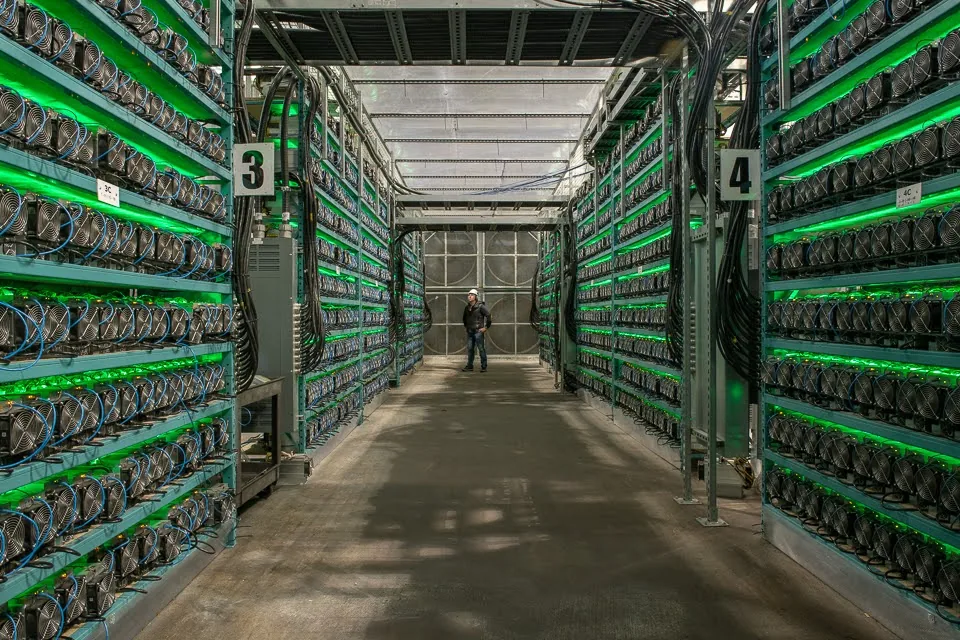
Our facility is built around that problem. Eight intake ducts pull outside air in, it passes through 156 Summer/Winter Air Filtration, crosses the racks and leaves through four exhausts. Filtration is not a luxury: dust settles on heatsinks, insulates them, and the board runs hotter until chips degrade. It is the slow, invisible way air-cooled miners die, and it is why our on-site repair work is mostly fans and power supplies rather than hashboards.
3. Somebody noticing at 3am
Fans fail. Power supplies fail. Pool connections drop. At home, the clock on all of those starts when you happen to look. In a monitored facility it starts when the machine stops reporting.
Across a year the difference between 95% and 99% uptime is roughly fifteen days of production. That is the sort of gap that quietly decides whether a fleet paid for itself.
4. Repairs that do not involve a courier
We repair miners on site: diagnostics, fans, power supplies, control boards, hashboards, cabling. For hosted miners the labour is usually included and you pay for the spare part. The alternative — boxing a dead machine and shipping it to a repair shop — costs weeks of downtime on top of the repair itself.
The things people underestimate about home mining
Set the economics aside for a moment. These are the practical problems, in the order people hit them.
- The electrical work. A 3.5 kW miner needs a dedicated 240 V circuit. That means an electrician, a permit, and a panel with capacity to spare. Running one off a standard household outlet through an adapter is a fire risk, not a shortcut.
- The noise. An air-cooled ASIC at full load is roughly as loud as a vacuum cleaner, and it never stops. Not at night, not at the weekend. This is the single most common reason home miners quit, and it is why "I'll put it in the garage" rarely survives the first week.
- The heat, again. The heat has to go somewhere, and in a house it goes into the house.
- The dust. Household air is full of it. Without filtration it ends up on the heatsinks.
- Your internet. Mining needs very little bandwidth but hates instability. A domestic connection that drops for ten minutes an evening is costing you production.
- Insurance. It is worth asking your home insurer how they feel about a continuously running 3.5 kW industrial appliance on a dedicated circuit before you find out the hard way.
When home mining does make sense
It would be dishonest to say never. There are three cases where mining at home is a reasonable decision:
- You have genuinely cheap power. Some regions, some tariffs and some self-generation setups put you under the break-even line. If your all-in rate is below your machine's break-even price, the arithmetic works — the practical problems remain, but they are yours to accept.
- You are using the heat. If a miner is replacing electric heating you would otherwise be paying for, part of the power cost is doing a second job. This works in winter and stops working in spring.
- You are learning. Running one machine to understand pools, firmware, monitoring and failure modes is a legitimate education, and much cheaper than learning it across fifty hosted units.
What does not make sense is running a handful of machines at residential rates and hoping the Bitcoin price rescues the position. That is not mining, it is an expensive directional bet with a noise problem.
Comparing the two honestly
| Home mining | Hosted mining | |
|---|---|---|
| Electricity price | Residential, all-in, usually above break-even for most hardware | $0.072–$0.089 USDT/kWh all-inclusive |
| Cooling | Yours to solve, hardest in summer | Filtered air, built for the load |
| Noise and heat | In your house | In an industrial building |
| Uptime | Whatever you notice | Monitored continuously |
| Repairs | You, or a courier and a wait | On site, labour usually included |
| Electrical work | Dedicated 240 V circuit, electrician, permit | Already there |
| Setup time | Days to weeks | Usually 1–2 business days after arrival |
| Control | Total — physical access any time | Your pool, your wallet; the hardware is in our building |
| Minimum commitment | One machine | 5 miners, from 6 months |
The last two rows are the real trade-off, and we would rather name it than pretend it does not exist. Hosting means your hardware is in somebody else's building. You cannot walk over and look at it. That is a genuine cost, and it is why choosing a provider carefully matters more than squeezing the last tenth of a cent off the rate — we wrote /how-to-choose-a-bitcoin-miner-hosting-provider/a checklist for exactly that.
How to decide, in about ten minutes
- Find your real electricity rate. Take your last bill, divide the total by the kilowatt-hours used. Use that number, not the advertised energy rate.
- Find your machine's break-even price in the table above, or run it on our mining profitability calculator.
- Compare them. If your rate is above break-even, home mining loses money today and will lose more after the next difficulty increase.
- If it is below, check the practical list. Circuit, noise, heat, dust, internet, insurance. Any one of them can end the project.
- Then compare against a hosting quote for the same machines, counting every fee on both sides.
Most people who do this properly end up hosting, which is admittedly convenient for us to say. The useful part is that the arithmetic is the same whoever does it, and you can check ours: every figure in this article comes from the same published numbers behind our supported miners table and our rate card.
If you want the comparison run against your own fleet and your own power price, send us the model mix and we will tell you where it lands — including when the answer is that hosting does not improve your position.
More mining & hosting insights
Shipping ASIC miners to Canada: what actually happens at the border
Getting mining hardware into Canada is routine freight, done thousands of times a year. It becomes difficult in exactly one situation: when the shipper improvises the customs side and finds out what they got wrong after the shipment has alr
Read more
Bitcoin Data Center: Why Professional Hosting Changes Your Mining Operation
Bitcoin mining data centers provide efficient power redundancy, modern cooling systems, and around-the-clock technical support compared to a home mining rig. Professional miner data centers operate at an ideal temperature, which minimizes s
Read more
Cryptocurrency Mining In 2026: Maximize Your ASIC Hardware ROI With Professional Crypto Hosting
Cryptocurrency mining profitability depends on electricity costs, hardware efficiency, and network difficulty, not just coin selection. Mining of Bitcoin can demand industrial ASIC hardware and procure electricity at prices lower than $0.08
Read more